

Appearance
Skip to content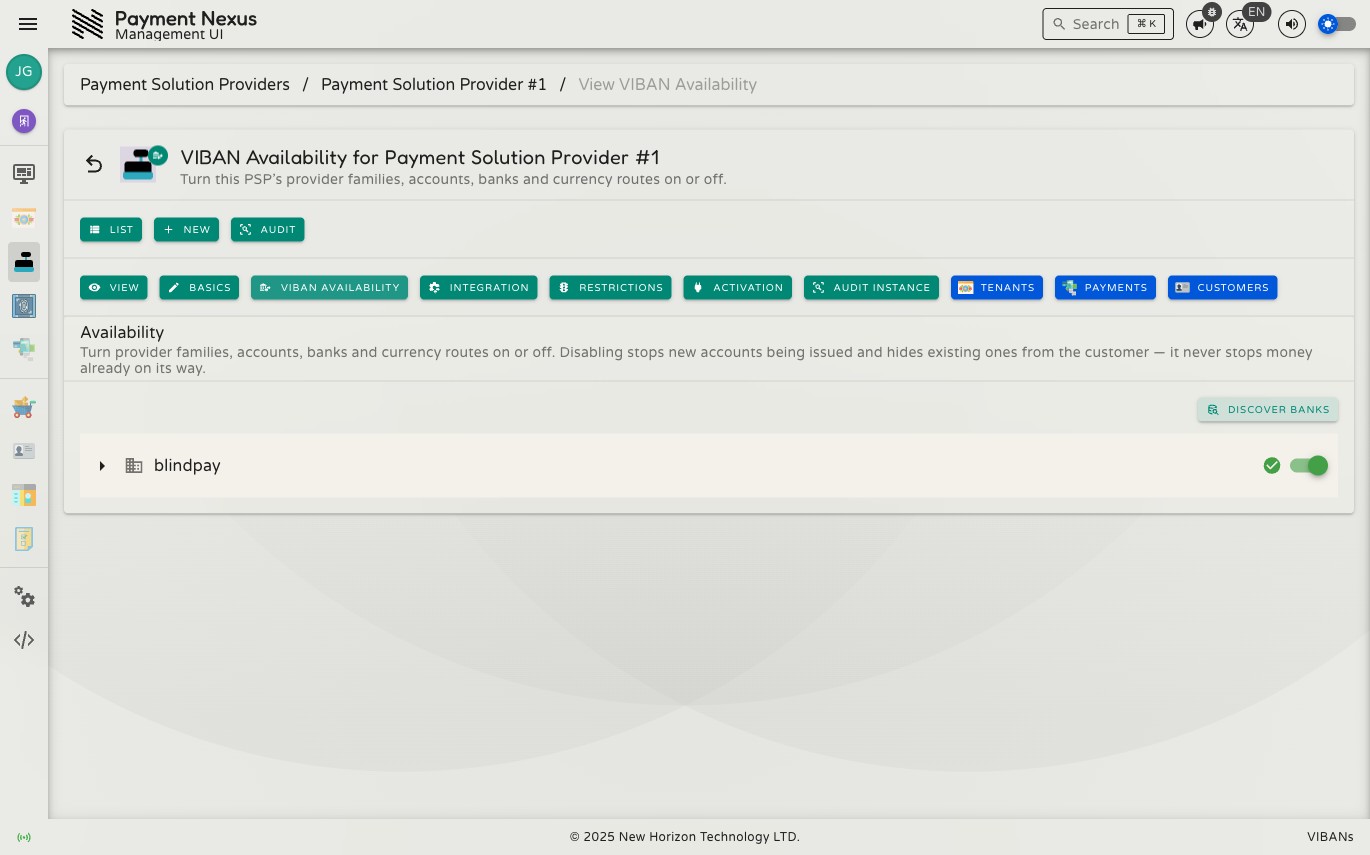
Turning Off Part of a Provider's Availability
You may need to disable availability during bank maintenance, when consolidating merchant identification numbers (MIDs), or while reviewing a compliance issue on a currency route. This guide explains the effect of disabling availability at each level of the hierarchy before you confirm the change.
All availability settings are managed on the VIBAN Availability page for the selected provider. You must enter a reason before confirming any change.
The rule that applies everywhere
Regardless of the level you disable, the following three rules always apply:
- New accounts stop. The system cannot issue new accounts under the disabled level.
- Existing accounts are hidden, not deleted. Customers can no longer select the account to deposit funds, but the account record remains in the system.
- Money already in transit is unaffected. If a deposit is on its way to an account issued before the change, the provider still reports the deposit and Payment Nexus processes it normally.
The level you disable determines which other accounts and routes are affected.
Turning off an entire provider family
Disabling a provider family affects all accounts, banks, and currencies under every MID in that family. The system stops issuing new accounts for the family, and existing accounts are hidden from customers. Other provider families are not affected. Customers with virtual IBANs from other provider families experience no change.
Turning off one provider account (MID)
Disabling a provider account (MID) disables all banks and currencies under that specific MID. Other MIDs in the same provider family remain unaffected.
Customers who already hold a virtual IBAN under the disabled MID are not moved to a different MID in the same family, even if another MID remains available. For details on why automatic reassignment does not occur, see When a Customer Already Has a VIBAN With a Provider. Customers can still provision a virtual IBAN through a different provider family if one is available.
Turning off one bank
Disabling a bank disables all currencies associated with that bank. Customers assigned to that MID can still provision an account through a different bank under the same MID, provided that bank supports the required currency. For example, if you disable the only currency supported by a bank, no routes remain active for that bank. However, customers can still obtain that currency through another active bank under the same MID.
Turning off one currency route
Disabling a currency route affects only that specific bank and currency combination. Other currencies at the same bank continue to operate normally. Customers who need that currency can provision it through a different bank under the same MID if available, or continue using their existing active accounts.
Turning something back on doesn't cascade upward automatically
Re-enabling a bank or currency restores only that specific item. If a parent level (such as the provider account) remains disabled, child entities remain inactive until you re-enable the parent. Conversely, re-enabling a parent level restores child entities only if they were active when the parent was disabled. Any child entity that was disabled independently remains disabled until you re-enable it separately.
Before you confirm
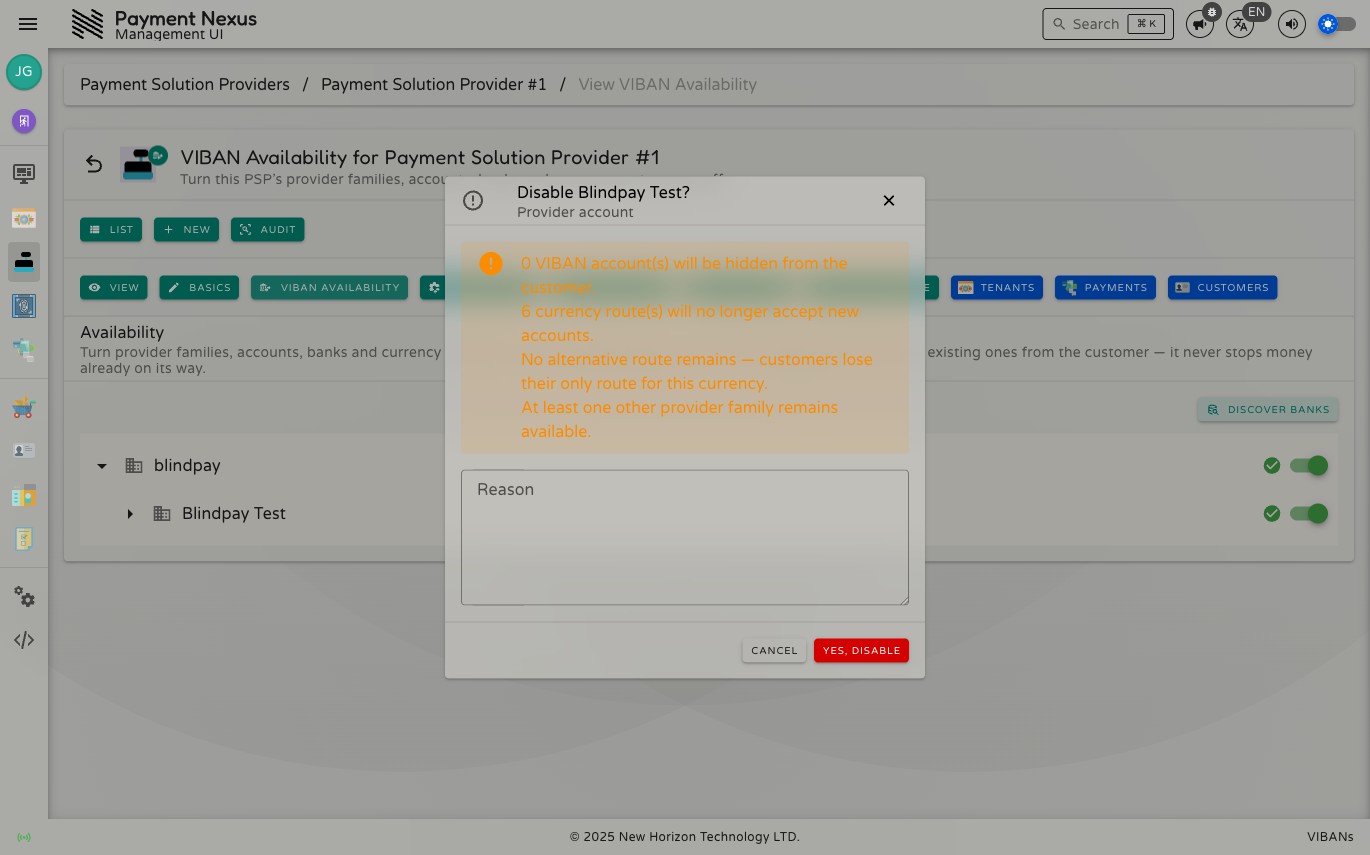
The confirmation dialog displays an impact summary before changes take effect. This summary lists the number of existing accounts that will be hidden, the number of currency routes that will stop accepting new accounts, and whether alternative routes or provider families remain available to affected customers. Review this summary carefully before confirming the action.